The Current Land System: A Potted History
A brief (and incomplete!) run through of how we got to the land system we have today. Spoiler: through vast amounts of violence and injustice.
Introduction
The current picture of land and nature access for most people in England is clear. Studies have shown that the more economically deprived the area, the less likely that area will have access to green space, and despite making up 10% of the population, only 1% of national park visitors are racially minoritised (National Trust, 2020). In Cymru, studies have shown that there are financial barriers to accessing land for food production in cities, as well as issues such as rural racism to contend with. Although access to land for people with disabilities is disappointingly under researched, the broad outlook shows that stigmas and stereotypes, as well as a lack of appropriate infrastructure, create more barriers.
A Potted History - the Bigger Picture
Painting the picture of access to land for many people in the UK necessitates a look back in time. Private land ownership largely emerged through the conquest of Ireland and Cymru, amid land enclosures in England and land grabbing in the Global South from the 12th Century onwards. In the space of just over 300 years, from 1604, almost 7 million acres of land were enclosed (read: stolen by the wealthy) in England as a result of successive enclosure bills. Peasants were forced to suit the landowning elite's needs to make way for livestock rather than subsistence farming, and parliament criminalised traditional ways of living in connection with the land, in part by steadily privatising it.
And it wasn’t just the land closest to home that Britain wanted for itself. Through violent conquest, genocide, land-grabbing and exploitation, 23% of all land on Earth was stolen by the British Empire in a colonial project that, far from ending, has simply continued with a different face. (More on this in a later blog!)
This context is important - we are where we are today because of this history, with 50% of land in England owned by less than 1% of the population - aristocrats and corporations making up most of this figure. The current land ownership system is shaped by a history which we cannot always see in the present day, yet inevitably affects who gets to freely access, enjoy, and make livelihoods from land and who doesn’t.
Within a few hundred years, relationships, rules and laws about land drastically shifted from something which looked more like land as a commons, to a much more hierarchical power structure, which unfortunately remains the case today. With a right to roam in place for only 8% of land in England and land ownership largely concentrated in the hands of a minority of wealthy people, the legacy of this history remains.
We must look at the current context of access to land through this historical lens if we are to understand how to move forward into a more equitable future.
Food & Farming
Zooming inwards to the food system and the horticultural sector, we can see that there are a plethora of barriers and inequalities for marginalised people in food and farming in the UK. Studies have outlined that the sector's reliance on unpaid work to gain experience, as well as the low pay and high expectations on workers, marginalises those with less financial security and creates a self-fulfilling prophecy where mostly the financially privileged can step into agroecology easily. Racism and racial inequity continue to proliferate in the agroecology sector too. Opportunities are then missed for low income or working class people, as well as Global Majority people, to better meet their food needs e.g. through producing culturally-appropriate food suitable for a UK climate. Agriculture is also the least racially diverse sector in England, and new entrants, especially those who are young and without a background in farming, face significant barriers in both accessing training and land in the sector.
A lack of diversity in agriculture is also part of a wider issue of economic injustice, both more broadly and within the food system itself. The Trussell Trust found that being low income and part of a minoritised ethnicity were two significant factors that lead to food insecurity. Thus inequalities in income can be mapped onto food inequalities between ethnic groups. The Runnymede Trust found that during the cost of living crisis, minoritised ethnic groups are 2.2 times more likely to live in deep poverty than white people relative to their population size, with Bangladeshi people more than three times more likely.
Conclusion
We cannot create agroecological futures without first addressing the harm that successive Global North governments and corporations have wreaked on the planet. Both at home and abroad, colonialism and the prioritisation of profit over all else has led us to the polycrises we face today. Land is a central factor in this violence, and therefore must be core to how we heal and repair.
We call on funders, wealth holders, landowners and those with resources to support us in righting the wrongs of history through reparations and land justice work. We call on farmers, land seekers, and those who are impacted by the injustice in our food and land-use systems to stand with us in fighting for a better world. And we ask that the movement towards agroecology refrains from reproducing capitalist logic and welcomes a more radical, transformative approach to shifting our economic system from the root.
Our future can look better than the present, but only if we work together and transform power from the ground - from the land - up.
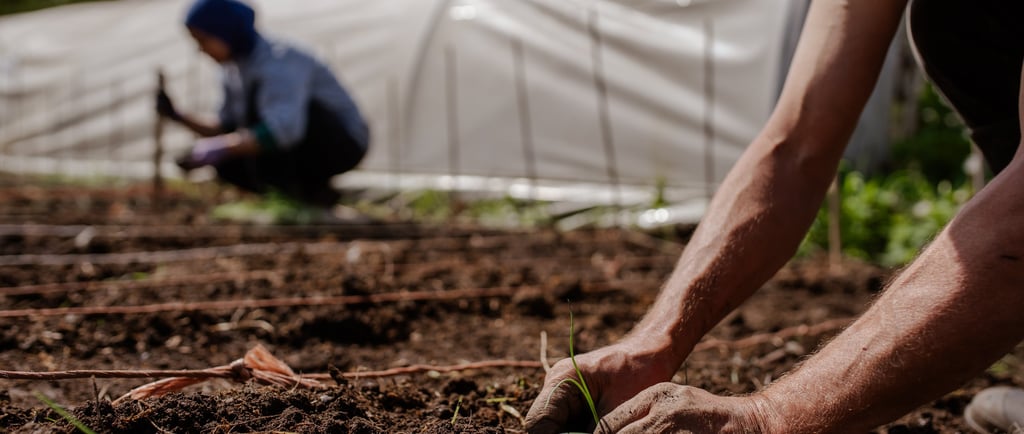
Photo credit: Willowbrook Farm, Photographed by Phoebe Davies for Culture Roots Collective, 2026